Independent OCIO search consulting

Outsourced CIO Search and Provider Selection

Alpha helps institutional fiduciaries run an outsourced CIO search—from governance preparation and market screening through RFP analysis, finalist diligence, negotiation, and transition planning.

Alpha is the institution’s search consultant. It does not provide OCIO services or compete for the mandate being awarded.

Building the initial provider universe? Explore OCIO Intelligence →

110+Institutional searches
$120B+Assets represented
100%Independently owned

Two different roles

Does “outsourced CIO consultant” mean a provider or a search consultant?

The phrase can describe two materially different relationships. An OCIO provider may manage the assets; an outsourced CIO search consultant advises the institution on how to evaluate and select that provider. Alpha performs the search-consultant role only.

OCIO PROVIDER

Manages delegated investment responsibilities

An outsourced CIO provider competes for the investment mandate and may accept authority for portfolio construction, manager selection, implementation, risk management, reporting, and other agreed responsibilities.

SEARCH CONSULTANT

Evaluates providers for the institution

An independent OCIO search consultant helps fiduciaries define the mandate, build the provider universe, run a comparable RFP, conduct due diligence, negotiate fees and terms, and document the selection.

Governance preparation

Define the mandate before asking firms to propose a solution.

An RFP cannot resolve an unsettled governance decision. The board, investment committee, staff, and other stakeholders should enter the market with a common view of the institution’s objectives and decision rights.

Alpha begins with the institution’s current investment program, committee structure, resources, constraints, and desired degree of delegation. That work becomes the search brief and the basis for evaluating fit.

Governance brief

Questions to answer before outreach

  • Why is the institution reviewing the current model now?
  • Which policy, allocation, manager, and implementation decisions will be delegated?
  • Which objectives, liquidity needs, liabilities, restrictions, and legacy assets shape the mandate?
  • Who will lead the search, score proposals, interview finalists, and approve the selection?
  • What reporting, service, education, and ongoing oversight does the committee require?
  • Which criteria are requirements, and which are preferences?

Selecting the evaluator

How should an institution choose an OCIO search consultant?

Institutions should evaluate an OCIO search consultant on five dimensions: independence, specialization, relevant search experience, evaluation resources, and verifiable external evidence. The strongest fit is the firm whose team, process, data, conflicts, and experience align with the institution’s mandate.

01

Independence

Does the firm offer OCIO or investment consulting services, compete for provider mandates, or maintain material commercial relationships with prospective providers?

02

Specialization

Is institutional provider selection central to the business, and does the proposed team understand OCIO governance, operating models, implementation, fees, and conflicts?

03

Relevant search experience

Has the firm completed searches for institutions with comparable assets, governance, portfolio complexity, objectives, and decision requirements?

04

Evaluation capabilities

Can the firm compare provider organizations, assigned teams, performance, risk, allocation, fees, operations, conflicts, and implementation using consistent evidence?

05

External evidence

Are the team’s credentials, publications, industry relationships, client references, and recognition verifiable and directly relevant to the proposed engagement?

Alpha is independently owned and does not offer competing OCIO or investment consulting services. Its work is informed by 110+ institutional searches, $120B+ in assets represented, former-allocator experience, and proprietary OCIO performance, allocation, risk, and fee data.

Read how to choose an independent OCIO search consultant →

End-to-end search stages

How to run an outsourced CIO search.

A defensible process carries the same mandate-specific criteria from initial governance discussions through provider screening, written proposals, finalist meetings, selection, and ongoing oversight.

  1. 01

    Confirm the search mandate

    Document why the review is happening, what would justify a change, which decisions are in scope, and who has authority to recommend and approve a provider.

  2. 02

    Prepare the governance brief

    Define objectives, delegated authority, liquidity, risk, investment constraints, service expectations, reporting needs, and the committee’s role after selection.

  3. 03

    Build and screen the market

    Map the provider universe and use consistent qualification criteria or a focused RFI to identify firms suited to the mandate—not simply the largest or best-known firms.

  4. 04

    Issue a mandate-specific RFP

    Ask each candidate for comparable information about the assigned team, investment approach, implementation, outcomes, fees, conflicts, operations, reporting, and transition.

  5. 05

    Evaluate proposals consistently

    Normalize responses and economics, test the evidence behind claims, and score candidates against the criteria approved before proposals were received.

  6. 06

    Conduct finalist diligence

    Use reference calls, targeted follow-up questions, finalist meetings, and demonstrations to examine the people and operating model the institution would actually receive.

  7. 07

    Select, negotiate, and transition

    Document the decision, negotiate fees and contract terms, assign implementation responsibilities, and establish the reporting and oversight plan for the new relationship.

Comparable provider information

Use the RFI to screen. Use the RFP to differentiate.

The request should fit the decision. A shorter RFI can establish whether providers meet essential requirements; a mandate-specific RFP can then compare the smaller group on the evidence that matters to the institution.

Scroll horizontally to compare

Search documentPrimary purposeUseful contentCommon mistake
RFI or initial screenReduce a broad provider universe to firms that can meet the mandate’s essential requirements.Business model, client fit, delegated services, minimums, relevant experience, high-level implementation, conflicts, and indicative fees.Requesting lengthy narratives before confirming basic fit.
RFPGenerate consistent, decision-ready evidence from qualified candidates.Assigned people, proposed portfolio, investment process, risk, performance context, operations, service, reporting, all-in fees, conflicts, contract terms, and transition.Using generic questions that produce polished but non-comparable answers.
Finalist agendaTest important differences and unresolved questions in the proposed relationship.Mandate-specific scenarios, assigned-team interaction, portfolio recommendations, implementation details, reporting demonstrations, references, and negotiation items.Repeating the written RFP instead of investigating judgment, fit, and execution.

Whole-relationship diligence

What should institutions compare across OCIO firms?

The provider’s name and headline fee do not describe the relationship the institution will receive. Evaluation criteria should connect the proposed people, portfolio, implementation system, economics, and conflicts to the mandate defined at the start.

01

Firm and alignment

Ownership, financial condition, incentives, client concentration, organizational change, regulatory history, and material conflicts.

02

People and service

Named relationship team, decision makers, staff capacity, continuity, access, communication, education, reporting, and governance support.

03

Investment process

Philosophy, asset allocation, manager research, portfolio construction, liquidity, risk management, customization, and use of proprietary products.

04

Evidence and outcomes

Relevant client experience, performance context, benchmarks, risk, peer comparisons, attribution, references, and the limitations of the evidence presented.

05

Operations and implementation

Custody, trading, valuation, compliance, cybersecurity, business continuity, legacy assets, data, reporting, and transition responsibilities.

06

Fees and contract

Advisory fee, breakpoints, underlying investment expenses, performance fees, custody and administration, transition costs, termination terms, and service commitments.

From proposals to implementation

Pressure-test the finalists, economics, conflicts, and transition.

Finalist selection is not the end of diligence. The institution should resolve who will serve the relationship, what it will pay, how conflicts will be managed, and how assets and responsibilities will move before the contract is finalized.

FINALISTS

Meet the team that will do the work

Bring the assigned relationship and investment professionals into the meeting. Use a common agenda, references, portfolio scenarios, and follow-up questions to test judgment, access, culture, and fit.

FEES

Normalize the all-in economics

Compare advisory fees and breakpoints alongside underlying investment expenses, custody, administration, performance fees, proprietary products, legacy-asset charges, and transition costs.

Understand OCIO fee structures →
CONFLICTS

Ask how incentives affect the mandate

Review ownership, affiliated services, proprietary products, revenue sharing, manager access, cross-selling, referral arrangements, and other compensation. Evaluate both the disclosure and the proposed controls.

TRANSITION

Define implementation before signing

Assign responsibilities for custody, accounts, data, legal review, assets in transition, illiquid holdings, reporting, committee approvals, communications, and the first oversight meeting.

Alpha’s independent role

A search consultant on the institution’s side of the table.

Alpha Capital does not offer outsourced CIO or investment consulting services. It therefore does not compete with the firms being evaluated for the provider mandate.

Alpha helps the committee prepare governance, define the mandate, identify qualified providers, design the RFI or RFP, compare proposals and fees, conduct finalist diligence, negotiate terms, document the decision, and plan implementation.

The work is informed by more than 110 institutional searches, the Alpha Nasdaq OCIO Index, and OCIO Analytics. Founder Brad Alford, CFA, directs Alpha’s OCIO and investment consultant search services; his prior allocator roles included leading investments for the Duke Endowment and Emory University.

Meet the former institutional allocator leading Alpha’s search work →

Recognized search experience

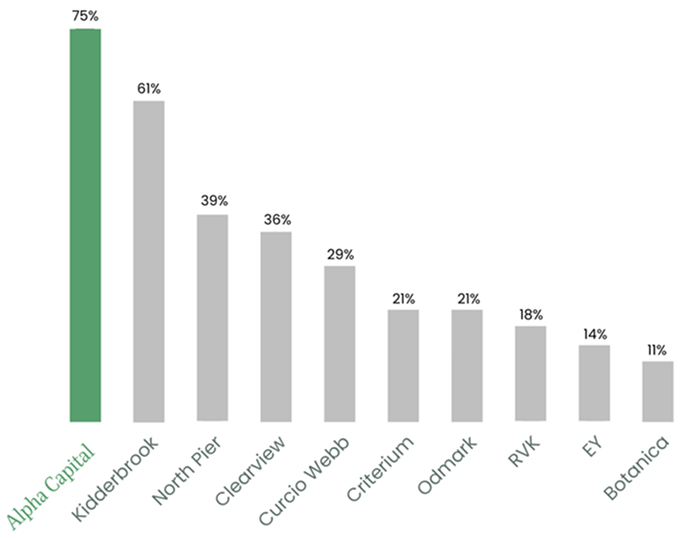
75% of surveyed OCIO providers cited Alpha among leading search firms in Cerulli’s 2024 survey.

OCIO providers citing Alpha Capital among leading search firms in Cerulli’s 2024 survey

Source: Cerulli Associates, 2024 Annual OCIO Report. Provider recognition is one market signal; the appropriate search consultant remains specific to each institution and mandate.

Common questions

Outsourced CIO search questions.

The right process depends on the institution’s governance, procurement requirements, decision trigger, and current provider relationship. These answers provide a starting point.

Is an outsourced CIO consultant the same as an OCIO search consultant?

Not necessarily. An outsourced CIO provider may describe its client professionals as consultants while the firm manages investments under delegated authority. An independent OCIO search consultant does not manage the institution’s assets; the consultant helps the institution define the mandate, evaluate providers, and select and negotiate the relationship. Alpha Capital serves only in the independent search and evaluation role.

What is an outsourced CIO search?

An outsourced CIO search is a structured process for identifying, evaluating, selecting, and transitioning to an OCIO provider. It normally begins with governance and mandate definition, then moves through provider screening, an RFI or RFP, proposal comparison, finalist diligence, fee and contract negotiation, selection documentation, and transition planning.

What does an independent OCIO search consultant do?

An independent OCIO search consultant works for the institution—not the providers being evaluated. The consultant helps fiduciaries define the mandate, identify qualified firms, structure comparable requests, analyze people, process, performance, risk, service, fees, and conflicts, conduct diligence, negotiate the relationship, and document the selection.

When should an institution run an OCIO search?

Common triggers include a change in governance or leadership, a decision to delegate more investment authority, persistent performance or service concerns, fee questions, portfolio complexity, provider consolidation, organizational growth, or a periodic review of the incumbent relationship.

Does every OCIO search require an RFP?

Not necessarily. Procurement policy, the reason for the review, the quality of existing information, and the number of potential candidates help determine whether an institution should begin with market research, an RFI, a full RFP, or an incumbent evaluation. The process should still use written requirements and consistent criteria.

How should institutions compare outsourced CIO firms?

Institutions should compare the whole proposed relationship: firm and ownership, assigned people, investment philosophy, portfolio construction, implementation, performance context, risk, operations, service, reporting, all-in fees, culture, conflicts, transition, and fit with the institution’s governance model.

Does Alpha Capital provide OCIO services?

No. Alpha Capital is an independent search and evaluation firm. It does not provide OCIO or investment consulting services and does not compete with the providers it evaluates.

Can Alpha evaluate an existing OCIO relationship?

Yes. An incumbent evaluation can benchmark the current relationship, examine outcomes and fees, test whether governance and service remain aligned, and help the institution decide whether changes or a broader market search are warranted.

Institution-specific searches

Start with the institution’s obligations—not a generic provider list.

Governance, liquidity, spending, liabilities, operating needs, portfolio complexity, and internal resources change what an appropriate outsourced CIO relationship looks like.

RETIREMENT

Pension and retirement plans

Evaluate providers in the context of liabilities, funded status, implementation, governance, and oversight.

Explore pension search →
ENTERPRISE

Healthcare organizations

Coordinate operating reserves, foundations, retirement assets, liquidity, and enterprise priorities.

Explore healthcare search →
OTHER POOLS

Other institutional investors

Build a mandate-specific search for asset pools with specialized governance or operating requirements.

Explore institutional search →

Related search guidance

CONSULTANTS

Investment consultant search

Define the advisory mandate and compare institutional consulting firms on people, advice, implementation, service, fees, and fit.

Explore consultant selection →
AUDIENCES

Institution-specific searches

Connect governance, liquidity, liabilities, operating needs, and portfolio constraints to the search requirements.

Explore institutional search needs →
RESEARCH

OCIO research and evidence

Use Alpha’s research, fee guidance, indices, and market intelligence to strengthen provider diligence and committee education.

Browse research and insights →

A better selection process starts here

Run a more defensible outsourced CIO search.

Whether your institution is exploring the OCIO model, evaluating an incumbent, or preparing a full RFP, Alpha can help structure the decision from governance through transition.

Discuss a Search