Does “outsourced CIO consultant” mean a provider or a search consultant?
The phrase can describe two materially different relationships. An OCIO provider may manage the assets; an outsourced CIO search consultant advises the institution on how to evaluate and select that provider. Alpha performs the search-consultant role only.
OCIO PROVIDER
Manages delegated investment responsibilities
An outsourced CIO provider competes for the investment mandate and may accept authority for portfolio construction, manager selection, implementation, risk management, reporting, and other agreed responsibilities.
SEARCH CONSULTANT
Evaluates providers for the institution
An independent OCIO search consultant represents the institution throughout provider selection and brings judgment, market knowledge, and an objective perspective to the decision.
When to search
Start with the trigger—not a provider list.
The right support depends on why the institution is reconsidering its investment model or current provider. Alpha helps the committee understand its options and the implications of change.
Considering OCIO for the first time
The committee needs to understand the range of delegation models and decide which responsibilities it should retain before comparing firms.
Governance or leadership change
New decision makers, limited committee capacity, organizational growth, or a more complex portfolio may require a different operating model.
Questions about the incumbent
Service, staffing, performance context, risk, fees, transparency, or strategic fit may warrant an independent review before deciding whether to search.
Periodic market validation
A documented review can test whether the current mandate, provider, terms, and governance structure continue to serve the institution’s objectives.
A search consultant on the institution’s side of the table.
Alpha Capital does not offer outsourced CIO or investment consulting services. It therefore does not compete with the firms being evaluated for the provider mandate.
Alpha brings independent search expertise and market evidence to complex provider decisions, with advice tailored to the institution rather than a generic procurement template.
The work is informed by more than 110 institutional searches, the Alpha Nasdaq OCIO Index, and OCIO Analytics. Founder Brad Alford, CFA, directs Alpha’s OCIO and investment consultant search services; his prior allocator roles included leading investments for the Duke Endowment and Emory University.
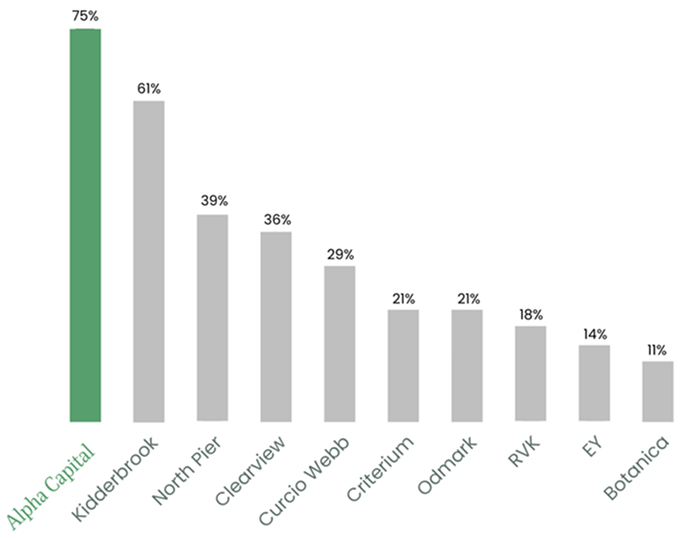
75% of surveyed OCIO providers cited Alpha among leading search firms in Cerulli’s 2024 survey.
Source: Cerulli Associates, 2024 Annual OCIO Report. Provider recognition is one market signal; the appropriate search consultant remains specific to each institution and mandate.
Common questions
Outsourced CIO search questions.
The right process depends on the institution’s governance, procurement requirements, decision trigger, and current provider relationship. These answers provide a starting point.
Is an outsourced CIO consultant the same as an OCIO search consultant?
Not necessarily. An outsourced CIO provider may describe its client professionals as consultants while the firm manages investments under delegated authority. An independent OCIO search consultant does not manage the institution’s assets; the consultant helps the institution define the mandate, evaluate providers, and select and negotiate the relationship. Alpha Capital serves only in the independent search and evaluation role.
What is an outsourced CIO search?
An outsourced CIO search is an institutional decision about whether and how to appoint an investment provider with delegated responsibilities. Alpha guides that decision as an independent adviser to the institution.
What does an independent OCIO search consultant do?
An independent OCIO search consultant works for the institution—not the providers being evaluated. Alpha helps fiduciaries make a well-supported provider decision tailored to their governance, investment needs, and service expectations.
When should an institution run an OCIO search?
Common triggers include a change in governance or leadership, a decision to delegate more investment authority, persistent performance or service concerns, fee questions, portfolio complexity, provider consolidation, organizational growth, or a periodic review of the incumbent relationship.
Does Alpha Capital provide OCIO services?
No. Alpha Capital is an independent search and evaluation firm. It does not provide OCIO or investment consulting services and does not compete with the providers it evaluates.
Can Alpha evaluate an existing OCIO relationship?
Yes. An incumbent evaluation can benchmark the current relationship, examine outcomes and fees, test whether governance and service remain aligned, and help the institution decide whether changes or a broader market search are warranted.
Institution-specific searches
Start with the institution’s obligations—not a generic provider list.
Governance, liquidity, spending, liabilities, operating needs, portfolio complexity, and internal resources change what an appropriate outsourced CIO relationship looks like.
MISSION
Endowments and foundations
Connect mission, spending, donor restrictions, liquidity, and committee resources to the provider mandate.
Whether your institution is exploring the OCIO model, evaluating an incumbent, or preparing a full RFP, Alpha can help structure the decision from governance through transition.