
Executive summary
Key takeaways
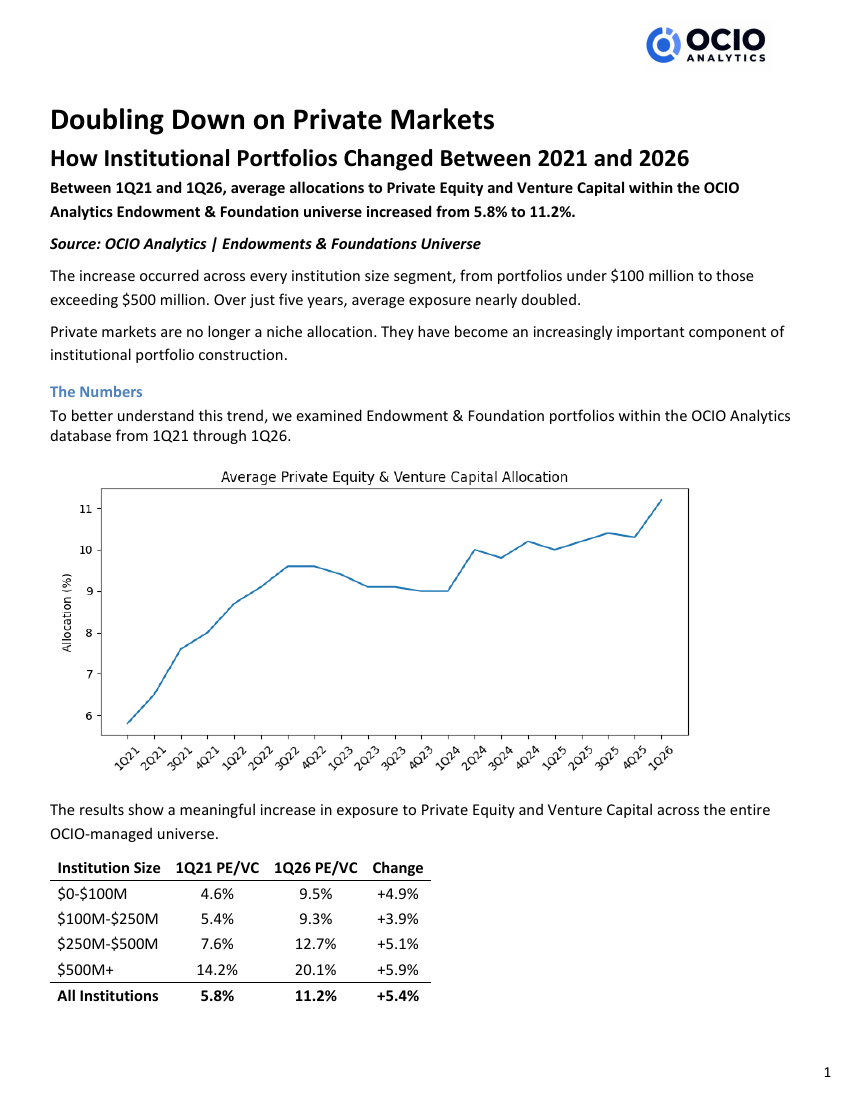
- Average PE/VC allocations rose from 5.8% in Q1 2021 to 11.2% in Q1 2026 in the report’s endowment and foundation universe.
- Every reported institution-size segment increased its exposure; the trend was broader than the largest portfolios.
- Reported invested allocations reflect earlier commitments and capital calls, so they do not show the entire commitment pipeline.
- The growth in exposure does not by itself establish improved investment performance.
01
A change in the institutional portfolio
The June 2026 OCIO Analytics paper examines private equity and venture capital allocations in its OCIO-managed endowment and foundation universe from Q1 2021 to Q1 2026. Average exposure nearly doubled over that interval.
For investment committees, the implication is that private-market oversight is increasingly part of the core investment program. It affects the institution’s liquidity planning, operating capacity, and the responsibilities delegated to an OCIO.
02
The increase across institution sizes
The paper reports the following observed allocations. Changes are expressed in percentage points, and “all institutions” is the universe average rather than a simple average of the four size groups.
Scroll horizontally to compare
| Institution size | Q1 2021 PE/VC | Q1 2026 PE/VC | Change |
|---|---|---|---|
| $0–$100 million | 4.6% | 9.5% | +4.9 points |
| $100–$250 million | 5.4% | 9.3% | +3.9 points |
| $250–$500 million | 7.6% | 12.7% | +5.1 points |
| $500 million+ | 14.2% | 20.1% | +5.9 points |
| All institutions | 5.8% | 11.2% | +5.4 points |
03
Invested exposure is only one part of the picture
Private-market commitments generally become invested exposure through capital calls over time. A current allocation can therefore reflect decisions made several years earlier rather than just the committee’s current intentions.
An oversight review needs to connect reported exposure with unfunded commitments, expected calls and distributions, spending needs, and the institution’s capacity to tolerate delayed exits. Institutions with the same invested allocation can have different future liquidity demands.
04
What this means for an OCIO mandate
As PE/VC becomes more significant, manager selection, pacing, diversification across vintage years, and access arrangements become more consequential parts of the relationship. Allocation targets alone do not describe the program.
The report documents a change in portfolio structure, not proof that higher private-market exposure improves long-term results. Any institution’s evaluation still needs its own objectives, fees, implementation evidence, valuation conventions, and liquidity constraints.